


Lytham Windmill stands tall and proud on the Green at Lytham seafront against East Beach. Inside is a fascinating exhibition and museum.
Throughout the year it’s a beautiful space to enjoy the fresh sea air, open skies and the great outdoors. It’s also a popular space for big events like Lytham War Time Weekend and Lytham Festival.
Explore Lytham Windmill
Lytham’s best known landmark is the spectacular white Windmill, stood in the centre of Lytham Green. We went for a walk along The Green, to take a look around the outside of the Windmill and Lifeboat Museum –
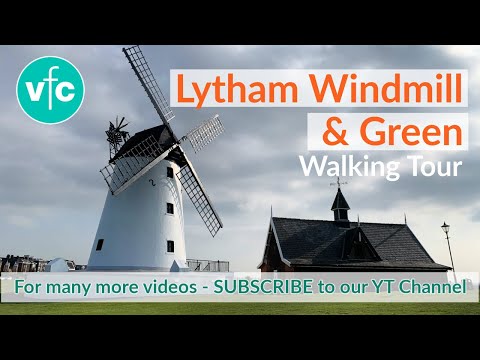
- If you’ve enjoyed this video, why don’t you subscribe to the Visit Fylde Coast YouTube channel?
And here’s some great aerial footage, with thanks to Robert Hudson –

Inside the Windmill
Call into the seasonal museum at Lytham Windmill where you can find out about its history. See exhibits on the “History of Mills and Milling” and the “Heritage of Lytham St Annes and the Fylde Area”.

Around 20,000 people a year visit the museum and the windmill – from the local area and from all over the world. You can see workings of the windmill, old and ancient Lytham. Learn about milling and bread making, Lytham school days. See the restored Victorian lifeboat.
FREE Newsletter
FREE Newsletter

Lytham Heritage Group began the museum in 1989 and it covers four floors inside the mill. Members still run it voluntarily and look after the displays and exhibitions. The Museum is a registered with the Museum, Libraries and Archive Council. Registration Number RD861.
2026 Opening Days/Times at Lytham Windmill
Lytham windmill and museum is open seasonally, but closed during the winter. Please check their website for opening times.
The Lifeboat Museum is currently open Fridays and Weekends only. Opening times are generally 10.30am -4.30pm. Closed on Mondays and Tuesdays/open for school parties by appointment only.
If you do go along, please say that you saw it on Visit Fylde Coast!
| Opening Dates | |
| Easter Period | Wednesday 1 April to Sunday 12 April Windmill – Wednesday to Sunday & Bank Holidays Lifeboat House – Friday to Sunday & Bank Holidays |
| Spring Season – | Saturday 18 April to Sunday 31 May Weekends & Bank Holidays Only |
| Summer Season – | Wednesday 3 June to Sunday 6 September Windmill – Wednesday to Sunday & Bank Holidays Lifeboat House – Friday to Sunday & Bank Holidays CLOSED Wednesday 24 June to Fri 10 July (Lytham Festival) |
| Autumn Season – | Saturday 12 September – Sunday 11 October Weekends Only |
| Special Events | |
| National Mill’s Weekend | Saturday 9 and Sunday 10 May |
| 1940s Wartime Weekend | Saturday 15 and Sunday 16 August |
| Heritage Open Days | Sat 12 to Sun 13 September & Sat 19 to Sun 20 September |
| Closed Lytham Club Day | Saturday 27 June CLOSED |
| Closed Lytham Festival | Saturday 24 June to Fri 10 July CLOSED |
Entry is free of charge, but of course donations are very welcome. Enjoy a fun and educational experience with the family. It takes about 20-40 minutes to view – and kids love it!
There’s also a Tourist Information Point in the Windmill during the season.
More about Lytham Windmill Museum
There’s a small handful of remaining windmills still standing here on the Fylde Coast. This one (Lytham), Little Marton Windmill, Marsh Mill at Thornton and Staining windmill.

Lytham Heritage Group manage the museum and regularly update the displays to keep it interesting and up to date.

Lytham Windmill is a key local landmark with a long history which stretches back over two hundred years. In that time the landscape has altered, there’s been big changes in society and huge changes in technology. The interesting exhibits capture some of this.


There’s still a huge amount which this group want to do, so keep popping in to see the latest developments. Enjoy projected images, sounds and video that bring the past to life for everyone, especially children.
Lytham Windmill Lifeboat Museum
The Old Lifeboat House next to the Windmill is part of the museum. Lytham Heritage Group also look after it. The Lifeboat Museum is currently open at weekends only.

It displays a full size Victorian Pulling and Sailing Lifeboat named Chapman from 1901. On display since autumn 2015, it’s beautifully restored to a very high level.
The Chapman is the first lifeboat to return to the Old Lifeboat House since 1931 when the Kate Walker was replaced by the JHW. It has strong links to the northwest and is a prime attraction for the museum. She is also a sister vessel of the St Annes No1 lifeboat ON587 James Scarlet that was on station from 1908 to 1925, when the St Annes station was finally closed. She was launched 9 times saving 20 lives.
Lytham St Annes now has a new lifeboat, kept at St Annes Lifeboat station.

The theme of the Lifeboat museum is the Great Lifeboat Disaster of 1886. When 27 lifeboat men from the St Annes and Southport crews lost their lives, trying to rescue 12 men from the shipwrecked barque the Mexico.
Volunteers are welcome to join The Group and assist with the day to day opening and stewarding of the museum. Contact thecentre@lythamheritage.co.uk for more information.
History of Lytham Windmill
The history of Lytham Windmill gives an interesting glimpse back into a long forgotten age.

The flat expanse of the Fylde Coast is very exposed to prevailing winds blowing from the Irish Sea. So it’s a popular spot for these buildings. In fact, there’s reference to windmills in documents dating as far back in time as 1190. And now modern wind turbines stand offshore for much the same reason.
Over 200 years ago, back in 1805 Richard Cookson, sought and obtained a lease from the Squire for a plot of land on which to build a ‘windy milne’ in the area then known as Lytham Marsh. It was always busy, serving the large area of farmland.
Interesting that in the 1840’s when the lovely houses of East Beach were being built by business men and mill owners, the residents saw the Windmill as an “industrial nuisance”.

Lytham windmill had three pairs of grinding stones:
- – One French pair,
- – One grey pair for meal,
- – and one pair of shelling stones
Attached to the rear was a corn drying kiln, used until 1881 and replaced with a new one at Kiln Street. The kiln housed a furnace fired by peat or wood, over which was laid a floor of 12″ square tiles, each perforated with small holes. Spread out over this floor, the warm air percolated through the tiles and grain, soon rendering it dry enough for milling.
When Fire Strikes a Windmill
Lytham windmill worked continually until a fire on 2 January 1919 burnt out the interior. Obviously you can have too much wind – because a tremendous gale turned the sails too fiercely. Despite the powerful brake, sparks were created which ignited the woodwork. The building was quickly ravaged by fire and its interior entirely gutted. The last miller was William Swann.
Lytham Windmill remained derelict until 1921 when the Squire gave it to Lytham Urban District Council. The burned-out interior was finally restored, and it was given a new cap and dummy sails. Over the years it was used as a café (1930-33), as the HQ for Lytham Cruising Club, the Motorboat Club, the Sea Cadets, an Electricity Board substation until 1964 and lastly as part of a Tourist Information Centre. During World War 2 it was even painted in camouflage colours.
In July 1988 the cap was removed, re-built and re-installed. Then in 1989 it was restored by Fylde Borough Council, opening to the public on 20 March in a ceremony conducted by the Mayor John Taverner.
Has this whetted your appetite? Find out more from Lytham Windmill and Museum website.
Now, there are just a small handful of windmills still standing on the Fylde Coast. This one, Little Marton Windmill, Marsh Mill at Thornton and Staining Windmill.
Lytham Windmill – Sailing in and out of Trouble!
On 1 October 2021, strong winds blew one of the sails off Lytham windmill. It looked a little strange, lopsided and three armed. When Fylde Council removed what was left of the broken sail it was completely rotten inside – and why it managed to break.

Sadly, on Wednesday 27 October 2021 another two sails blew off in another bout of stormy weather. Fylde Council removed the remaining sail during the following week.

On 28 April 2022 the bespoke replacement sails were fitted. They were crafted by veteran millwright Joe Gillett and his skilled team. The new sails were made at Joe’s workshops with wood from the western coast of the United States due to their size and length. Here they are in the next photo – they required a settling-in period of several weeks before they could be installed.


Would you like your own Windmill?
This Seaside Emporium print is available in a variety of sizes and frame options from the Care for Cleveleys Shop. All profits are reinvested into improving Cleveleys.

While you’re here…
Go to the homepage of the Visit Lytham website for the latest updates.
Love the Fylde Coast? Sign up for your email newsletter. Packed full of interesting things it arrives in your inbox all 52 weeks of the year.
Join us on Facebook at our Visit Fylde Coast Facebook Group and follow us on Twitter @visitFyldeCoast
Plus hundreds of videos to watch on our YouTube channel – from all over the Fylde Coast!
Booking a stay? Pick a safe, clean and legal place to stay, at the very best price. Book with the Visit Fylde Coast and StayBlackpool guide.

We Need Your Help
We Need Your Help


